Managing a post-surgery vitamin regimen can feel like a full-time job. Many patients diligently swallow every pill on their schedule, only to be caught off guard when their subsequent lab results show a deficiency anyway. If you are doing the work but not seeing the results, the issue is rarely the number of pills you are buying — it is how your body is, or is not, absorbing them.
When it comes to your bone health after surgery, the "how" and the "what" of your calcium intake matter far more than the "how much." Your surgically altered anatomy changes the rules of absorption, and a routine built for your old body will quietly fail your new one. Let's look at the five most common ways calcium supplementation goes wrong after bariatric surgery — and exactly how to fix each one.
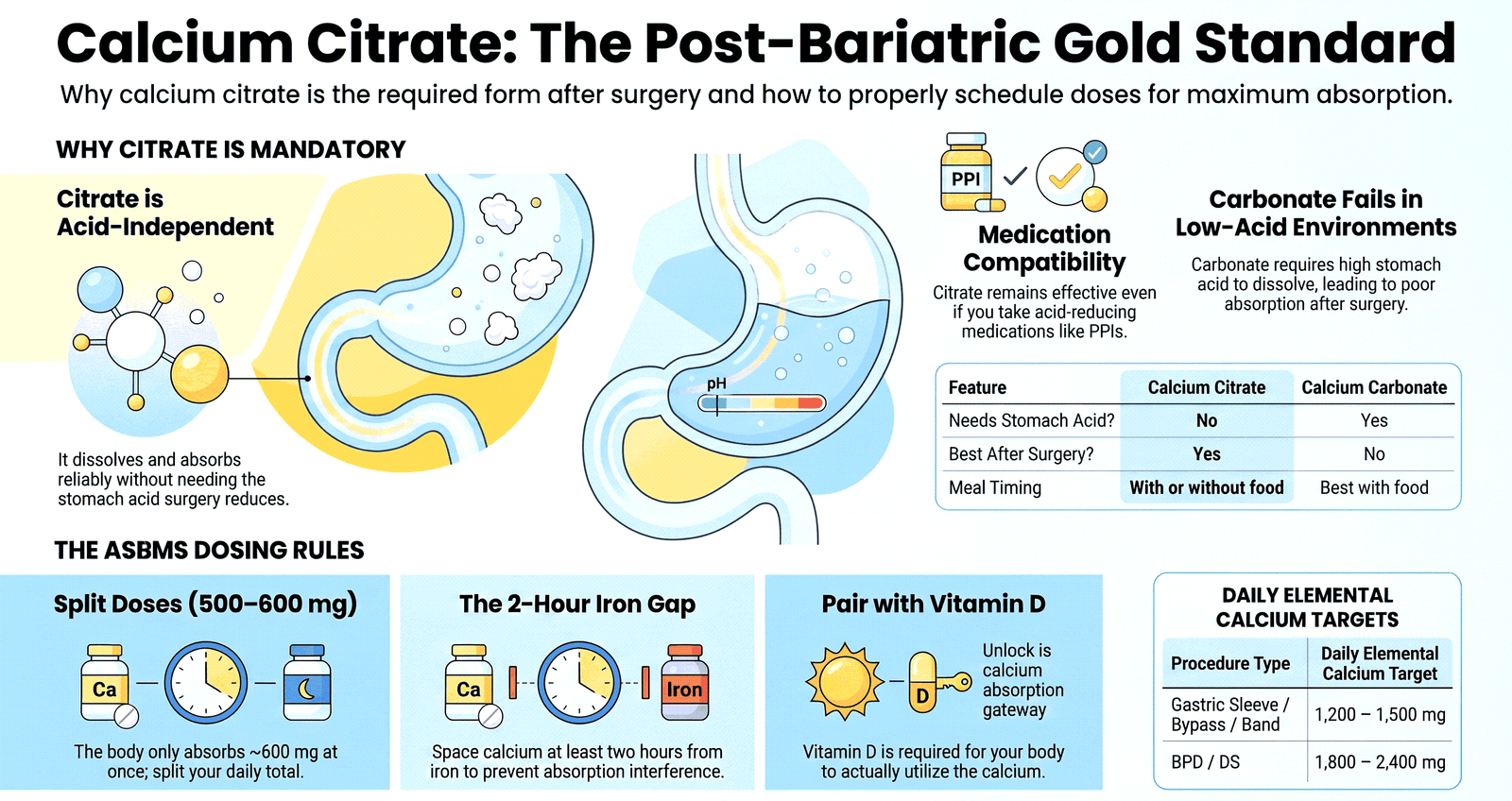
Buying calcium is not the same as absorbing it. After surgery you need the right form (calcium citrate, which is acid-independent — not carbonate), split into doses of 500–600 mg because your intestine can only process that much at once, separated from iron by at least two hours, calculated by elemental calcium (citrate is only ~21% usable), and paired with at least 3,000 IU of vitamin D3. Miss any one of these and the calcium on your label may never reach your bones.
1. The Acid Factor: Why Your Drugstore Calcium Is Failing You
The most common and inexpensive form of calcium on drugstore shelves is calcium carbonate. It works perfectly well for the general population, but it is almost certainly the wrong choice for you. Calcium carbonate is a salt that requires a high-acid environment to dissolve and become usable — and a high-acid environment is precisely what bariatric surgery takes away.
Your surgery creates what is best described as a "double whammy" for absorption. First, the procedure itself drastically reduces the amount of stomach acid you produce. Second, most patients are also prescribed proton pump inhibitors (PPIs) or other acid-reducing medications that eliminate what little acid is left. The result is a stomach environment in which carbonate simply cannot break down efficiently, so much of the calcium you swallow passes through unused.
As bariatric nutrition guidance emphasizes, calcium carbonate depends on stomach acid and must be taken with food. Calcium citrate is less dependent on acid and can be taken with or without a meal; a gastric bypass crossover study found greater bioavailability from citrate than carbonate. For the practical differences in elemental calcium, meals, dosing, and post-surgery use, review our calcium citrate vs carbonate comparison for bariatric patients.
2. The 600 mg Ceiling
Your body has a biological "gatekeeper" when it comes to calcium absorption. Regardless of how much you swallow at once, your small intestine can only process approximately 500 to 600 mg of calcium at a single time. If you take your entire daily requirement of 1,200 mg or 1,500 mg in one sitting, you are essentially flushing two-thirds of your investment down the drain.
The solution is split dosing: dividing your total daily target into smaller amounts spaced throughout the day so your body can actually use each one. This single-dose ceiling is built directly into the ASMBS nutritional guidelines, which specify that single calcium doses should not exceed 600 mg. Here is how that looks in practice for the most common procedures:
| Daily Target | Example Split |
|---|---|
| 1,200 mg (Sleeve / Bypass) | Two doses of ~600 mg (e.g., morning and evening) |
| 1,500 mg (Sleeve / Bypass) | Three doses of ~500 mg (e.g., morning, afternoon, and evening) |
| 1,800–2,400 mg (BPD/DS) | Four doses of ~500–600 mg (spaced every 3–4 hours) |
More is not better when the gatekeeper is already full. By spacing out your doses, you make sure your body actually utilizes the minerals you are providing rather than wasting the majority of them.
3. The Iron Rivalry: A Scheduling Conflict
A well-designed supplement schedule is a delicate balancing act, not just a checklist of pills to swallow in one handful. One of the most common mistakes is taking calcium and iron together. These two minerals compete for the same absorption pathways, and calcium is the bully in this scenario — it will effectively block your body's ability to use the iron.
The rule to remember is the Two-Hour Rule: calcium blocks iron absorption, so the two must be separated by at least two hours. This is not a fringe recommendation — the effect of calcium inhibiting iron absorption is well documented in human studies. If you take an iron supplement or a multivitamin that contains iron, wait at least two hours before taking any calcium. This one piece of timing is the secret to keeping both your energy levels (iron) and your bone density (calcium) at their peak, instead of sacrificing one for the other. If you are still sorting out your iron regimen, our guide to bariatric vitamins with iron walks through which forms actually absorb after surgery.
4. Decoding the "Elemental" Mystery
When you look at a supplement label, you will see the total weight of the compound — for example, "Calcium Citrate 1,000 mg." But the pill is not 100% calcium; it is a mix of calcium and the citrate carrier. The number that actually matters is the elemental calcium: the true usable amount of the mineral your body can put to work.
Consider the math. Calcium citrate is only about 21% elemental calcium. So if a pill contains 1,000 mg of calcium citrate, you are really only getting about 210 mg of usable calcium. This is exactly why you often need to take more pills than the front of the bottle implies in order to meet the American Society for Metabolic and Bariatric Surgery (ASMBS) guidelines:
- Sleeve, Gastric Bypass, and Adjustable Band: 1,200–1,500 mg elemental calcium daily.
- BPD/DS: 1,800–2,400 mg elemental calcium daily.
How to Read Your Label
- Label Weight: the total weight of the tablet, which includes the carrier compound.
- Elemental Calcium: the usable amount, found in the "Supplement Facts" panel. Always calculate your daily dose based on this number, never on the front-of-bottle weight.
Juggling acid-independent forms, split dosing, elemental math, and the two-hour iron rule is a lot to manage with tablets. Bari Liquid Force delivers bariatric nutrients in a pre-dissolved liquid form designed for a surgically altered digestive system — no acid required to break it down, and easier to split across your day.
See It on Amazon — 50% Off5. The Vitamin D Partnership
Calcium cannot work in isolation; it is a team player. For your body to effectively move calcium from your gut into your bones, it requires vitamin D3. Without adequate D3, the calcium you take may never reach its destination — no matter how perfectly you have handled form, dosing, and timing.
The ASMBS guidelines recommend pairing your calcium with at least 3,000 IU of vitamin D3 daily. But that floor is just the beginning. This dose should be titrated to your specific blood levels based on regular lab work from your care team, because individual needs vary widely. Nutrient teamwork is the real secret to long-term bone health. Many bariatric-specific calcium citrate supplements include vitamin D3 to simplify this synergy, but always make sure your total daily D3 intake matches your doctor's recommendation.
Conclusion: A Forward-Looking Summary
Optimizing your health after surgery requires a genuine shift in mindset — from simply "taking vitamins" to "optimizing absorption." At this point you may be wondering why you need a separate bottle of calcium at all. The answer is the Multivitamin Gap: a standard multivitamin simply cannot hold a full day's worth of calcium alongside all of its other nutrients. The required volume is too bulky to fit, which is why a dedicated calcium supplement is non-negotiable after surgery.
By choosing calcium citrate, splitting your doses, respecting the Two-Hour Rule with iron, calculating by elemental calcium, and pairing everything with vitamin D3, you turn your supplement routine into a precision tool built for your new anatomy. So ask yourself the honest question: is your current supplement routine designed for your body's new anatomy, or are you still following the rules of your old one? For more on building a complete regimen, explore our full ingredients breakdown or take the "Is It Right for Me?" quiz.